

Why Is My Car Vibrating While Driving?
A vibrating car is uncomfortable, but more importantly, it is a warning that something is out of balance or worn. Small vibrations rarely stay small.
25 November 20268 minute readAll 134 guides
Quick Summary
A car usually vibrates while driving because of a wheel or tyre problem, such as poor balance, uneven tyre wear or a bent rim. Worn suspension parts, a failing wheel bearing and damaged CV joints or driveshafts are the next most common causes. Vibration that follows engine speed points to a misfire or broken engine mounts, and shaking only under braking points to the brake discs. Where and when you feel it helps find the cause.
A vibrating car is uncomfortable, but more importantly, it is a warning that something is out of balance or worn. Small vibrations rarely stay small. The parts around them wear faster the longer they are ignored.
Your car is vibrating while driving most likely because of a wheel or tyre problem, such as poor balance, uneven tyre wear or a bent rim. Worn suspension parts, a failing wheel bearing or damaged CV joints and driveshafts are the next most common causes.
Engine misfires and broken engine mounts cause vibration that follows engine speed rather than road speed. Brake disc problems cause shaking only when you press the brake pedal.
Where You Feel the Vibration Tells You a Lot
The place where the shaking reaches you is one of the best clues to its source. Front-end faults usually travel up the steering column, while rear-end faults are felt through the seat and floor.
Problems in the brakes reach the pedal, and engine faults spread through the whole cabin. Paying attention to this one detail can save time at the workshop and point the technician in the right direction from the start.
| Where you feel it | Most likely source | Common causes |
|---|---|---|
| Steering wheel | Front wheels and steering | Front wheel imbalance, worn tie rods, bent front rim |
| Seat and floor | Rear wheels or drivetrain | Rear wheel imbalance, driveshaft or CV joint wear |
| Brake pedal | Brake system | Uneven brake discs, sticking caliper |
| Whole cabin, dashboard, mirrors | Engine | Misfire, broken engine mounts |
Shaking Through the Steering Wheel
When the steering wheel shakes, the cause is usually at the front of the car. Unbalanced front wheels are the most common reason, especially if the shaking starts at a certain speed and fades as you go faster.
Worn tie rod ends, ball joints and front wheel bearings can also make the wheel shake or feel loose. A bent front rim from a pothole or kerb strike creates a shake that gets stronger as speed rises. Because the steering connects directly to the front wheels, even small faults here are easy to feel.
Shaking Through the Seat and Floor
If you feel vibration in your seat or through the floor while the steering wheel stays calm, the rear of the car is the likely source. Rear wheel imbalance and uneven rear tyre wear are common causes.
On rear-wheel-drive and four-wheel-drive cars, a worn propshaft joint or centre bearing can also send vibration through the body.
Exhaust parts touching the floor because of a broken hanger may feel similar. Sitting in the back seat during a test drive often makes rear-end vibration much easier to feel.
When the Vibration Happens Matters Too
The timing of the vibration narrows the cause even further. Shaking that appears only at highway speeds usually comes from the wheels, while shaking at idle points to the engine.
Research on steering wobble published by SAE International shows that wheel imbalance often causes steering wheel vibration at highway speeds of about 80 to 120 km/h on smooth roads. That is exactly where UAE drivers spend much of their time.
| When it happens | Likely cause |
|---|---|
| Steady speed of 80 to 120 km/h | Wheel imbalance or tyre fault |
| Gets worse the faster you go | Bent rim, damaged tyre, worn wheel bearing |
| While accelerating | Worn CV joint, driveshaft or engine mount |
| At idle or standing still | Engine misfire or broken engine mount |
| When turning | Worn CV joint or wheel bearing |
| When braking | Uneven brake discs |
| Over bumps | Worn suspension parts |
Wheel and Tyre Problems
Wheels and tyres cause most vibration complaints, and they are usually the cheapest to fix.
Wheel Balance and Lost Weights
No wheel and tyre is perfectly even in weight. During fitting, small weights are attached to the rim to balance it. These weights can fall off after hitting a pothole or kerb, or when tyres wear unevenly.
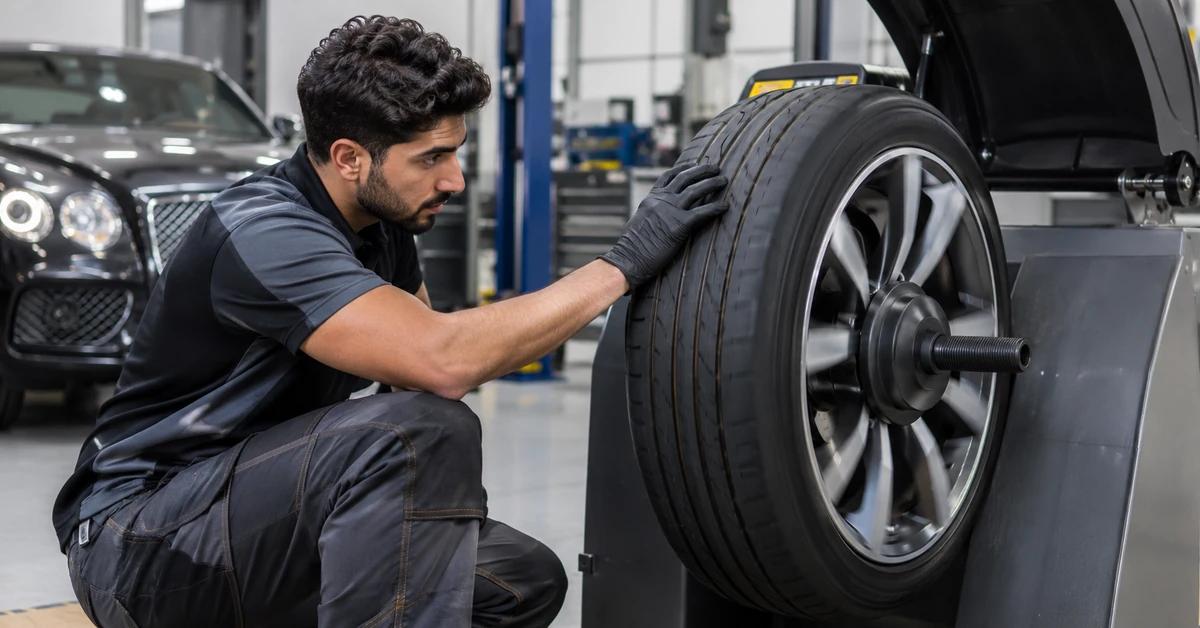
An unbalanced wheel wobbles as it spins, and the force grows quickly with speed. Wheel balancing on a machine takes only a short time and fixes the problem in most cases. It is also wise to balance wheels whenever new tyres are fitted or after a tyre repair.
Uneven Tyre Wear and Damage
Tyres that wear unevenly lose their round shape, which creates vibration even when the wheel is balanced. Uneven wear often comes from poor alignment, worn shock absorbers or wrong tyre pressure.
Damaged tyres with bulges, cuts or separated belts are dangerous and must be replaced. In the UAE, cars parked for long periods in summer can also develop flat spots. Checking tyres monthly helps catch these problems early, and correct wheel alignment stops new tyres from wearing the same way again.
Bent Rims
Alloy rims, especially the large, low-profile rims on luxury and sports cars, bend easily when they hit potholes, kerbs or speed bumps. A bent rim cannot be balanced properly, so the vibration returns no matter how many times it is balanced.
It may also leak air slowly. A technician can check the rim for runout on a balancing machine. Minor bends can often be straightened by a rim specialist, but cracked or badly bent rims should be replaced for safety.
Suspension and Drivetrain Wear
When the wheels are fine, the problem usually lies in the parts that hold and drive them.
Worn Suspension Parts
Ball joints, tie rod ends, control arm bushings and shock absorbers keep the wheels steady and in line. As they wear, the wheels can wobble or shake at speed, often with knocking sounds over bumps and uneven tyre wear.
Heat and constant speed bumps speed up this wear in the UAE. Replacing worn suspension parts usually removes the vibration and also makes steering feel tighter. Wheel alignment should always be checked after suspension parts are replaced.
Wheel Bearings
Wheel bearings let the wheels spin smoothly. When a bearing wears out, it often starts with a humming or growling noise that rises with speed and changes when you turn. As the damage grows, it can cause vibration felt through the floor or steering wheel.
A badly worn bearing can overheat and fail, which is dangerous at high speed. Technicians test bearings by lifting the car and checking for play and noise while spinning the wheel. A worn bearing should be replaced as soon as it is found.
CV Joints and Driveshafts
Constant velocity joints connect the driveshafts to the wheels and let them turn and move with the suspension. A worn inner CV joint often causes vibration when accelerating, while a worn outer joint usually clicks on tight turns.
Torn rubber boots let grease escape and sand get in, which wears the joints quickly. On some cars, driveshafts and propshafts can also lose balance. Repairing or replacing these parts through a driveshaft repair restores smooth power delivery and stops the shaking.
Engine-Related Vibration
If the vibration changes with engine speed rather than road speed, the engine is the likely source.
Engine Misfires
An engine misfire happens when one cylinder fails to burn fuel properly. The engine then runs unevenly, causing shaking that is often worst at idle or under load. The check engine light may flash, and the car may feel weak.
Common causes include worn spark plugs, failing ignition coils and dirty fuel injectors. Driving with a misfire can damage the catalytic converter, so it should be fixed quickly. Many engine misfires are resolved by replacing plugs or a single faulty coil.
Broken Engine Mounts
Engine mounts hold the engine in place and absorb its vibration before it reaches the cabin. They are made of rubber and sometimes filled with fluid, and UAE heat makes them crack and harden over time.
Broken mounts let vibration through at idle, especially with the AC on, and cause clunks when pulling away or changing gear. Common engine mount signs include extra cabin shaking and visible engine movement when revving. Replacing worn mounts restores a smooth, quiet ride.
Is It Safe to Keep Driving?
Mild vibration from wheel balance is not an emergency, but it should be fixed soon because it wears out tyres, bearings and suspension parts. Strong vibration, shaking with knocking or grinding noises, or vibration with a warning light is more serious.
These signs can point to a failing bearing, a damaged tyre or a broken suspension part that may affect steering and braking. In these cases, reduce speed and have the car checked as soon as possible. If the shaking is severe, it is safer to arrange recovery than to keep driving.
How Al Zaabi Autocare Finds the Cause
Al Zaabi Autocare starts every vibration check with a road test at the speed where the shaking appears. The car is then lifted and inspected for wheel, tyre, suspension, bearing, driveshaft and engine mount wear.
Wheels are checked for runout and balanced, and alignment is set to factory figures. If the cause is a misfire or another engine fault, computer diagnostics confirm it before any parts are replaced. Every repair comes with a clear quotation and a warranty on workmanship, and the Mussafah workshop is open seven days a week.
Frequently Asked Questions
Why does my car shake at 100 km/h but feel fine at lower speeds?
This usually means a wheel is out of balance or a tyre has uneven wear. Imbalance forces grow with speed, and many cars have a natural vibration range around 80 to 120 km/h. Wheel balancing normally fixes it quickly and cheaply.
Can bad wheel alignment cause vibration?
Alignment problems rarely cause vibration directly. They do cause uneven tyre wear, and those worn tyres then vibrate at speed. If your car also pulls to one side, have the alignment checked along with the wheel balance.
Why does my car vibrate when I accelerate?
Vibration only during acceleration often points to a worn inner CV joint, a driveshaft problem or broken engine mounts. A technician can road test the car and inspect these parts to find which one is causing the shaking.
Why does my car shake when stopped at a traffic light?
Shaking at idle usually comes from the engine side. A misfire, dirty injectors or broken engine mounts are common causes. If the shaking gets worse when you switch on the AC, worn engine mounts are a strong suspect.
How much does it cost to fix car vibration?
Cost depends on the cause. Wheel balancing is quick and inexpensive, while suspension, bearing or driveshaft repairs cost more. A proper inspection identifies the exact fault, so you only pay for the parts and labour your car actually needs.
Conclusion
A vibrating car is giving you useful clues about what is wrong. Where you feel the shaking and when it happens help point to the exact cause. Wheel balance, tyre wear and bent rims cause most cases, followed by worn suspension parts, wheel bearings and CV joints.
Engine misfires and broken mounts cause vibration at idle, while brake disc problems cause shaking only when braking. For an accurate diagnosis and lasting fix, book a suspension repair and vibration check with Al Zaabi Autocare in Mussafah.
Car Suspension Repair at Al Zaabi Autocare
Knocking over speed bumps, a car that sits low on one corner, or uneven tyre wear all point at suspension. We replace what is worn and check the geometry afterwards so the fix actually holds.
- Control arms, bushes and ball joints
- Shock absorbers and struts
- Air suspension compressor and bag replacement
- Anti-roll bar links and mounts
Other Suspension Guides
Think this is what your car is doing?
Bring it in and we will tell you. Free 360-degree health check and a written quote before any work starts.
- Where we are
- Plot no 69, Mussafah M-37, Abu Dhabi, UAE
- Opening hours
- Mon to Sat 9:00 AM to 10:00 PM
Sunday 9:00 AM to 7:00 PM